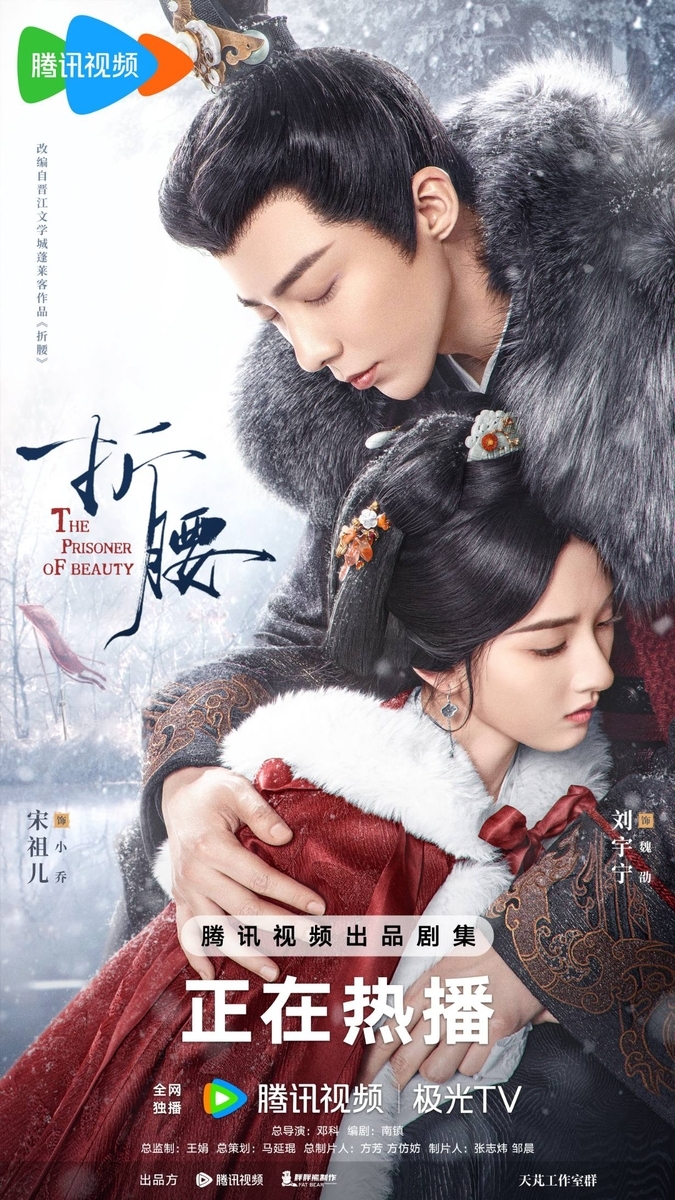
Opening Thoughts
The Prisoner of Beauty should not have worked for me as well as it did.
I am not exactly known for my patience when it comes to romance. Give me chemistry, give me kissing, give me an actual relationship, and please do not make me wait thirty episodes for it.
Yet somehow, The Prisoner of Beauty made me willingly sit through one of the slowest romantic developments I normally tolerate—and I loved it. The difference is that the slow burn actually serves a purpose.
Wei Shao and Xiao Qiao do not fall in love because the drama suddenly decides they should. They begin their marriage with years of family hatred sitting between them. There is distrust, resentment, political necessity, and a history neither of them can simply ignore.
Watching those walls gradually come down is the romance. And that is where this drama got me.
The Slow Burn That Somehow Worked on Me
I normally dislike very slow romance, so I went into this expecting to be impatient. Wei Shao and Xiao Qiao start with a political marriage, distrust, resentment, and complicated family history. There is very little genuine emotional intimacy between them at first.
Instead of asking me to accept a sudden change of heart, the drama lets their relationship shift a little at a time. They move through reluctant cooperation, growing respect, trust, emotional attachment, loyalty, and eventually love.
The romance works because their feelings change alongside their character development. We actually watch the relationship become something different, and this is one of the rare dramas that made me understand why people enjoy a properly written slow burn.
Wei Shao’s Character Development
Wei Shao begins the drama carrying anger, resentment, and assumptions built from the history between their families. He is guarded and convinced that the past tells him everything he needs to know about Xiao Qiao and her family.
Xiao Qiao does not magically fix him. His experiences with her gradually challenge what he believes, and he has to reconsider those old feelings for himself. That difference matters to me because his change feels like his own work, not a personality transplant caused by a wife-shaped cure.
Over time, he becomes more trusting and emotionally open, less controlled by that resentment, and increasingly protective and devoted to Xiao Qiao. His transformation is gradual, and it is one of the strongest parts of the drama.
Xiao Qiao’s Character
Xiao Qiao is intelligent and emotionally controlled, and she understands how dangerous her position is after marrying into a family that has every reason to distrust hers. She has to read the political situation, decide when compromise will help, and recognize when she needs to stand her ground.
Her strength comes through diplomacy, patience, and knowing how to move through a complicated situation. She does not need to carry a sword or physically overpower everyone around her to prove she is strong.
She is not passive or helpless. Her intelligence and emotional maturity are a big part of why this marriage eventually has a chance to work.
Wei Shao and Xiao Qiao’s Romance
Their relationship moves from political marriage to reluctant allies, then to trust, emotional dependence, love, and a genuine husband-and-wife partnership. It feels like a progression instead of a switch being flipped because the script has reached a certain episode.
Liu Yuning and Song Zu’er have strong chemistry, which helps carry the slower sections. As Wei Shao begins to fall for Xiao Qiao, his behavior becomes more protective and devoted, but the romantic payoff lands because we have spent time seeing how they got there.
This is not instant romance, and it is definitely not fluffy from the beginning. It is a relationship built out of two people learning to trust each other while a whole lot of old family mess sits between them.
Liu Yuning: Yes, My Husband Is Here
Yes, one of my husbands is in this drama, so obviously I came into this with absolutely no bias whatsoever.
None.
Zero.
Moving on.
Jokes aside, Liu Yuning fits Wei Shao naturally. His commanding physical presence, voice, and restrained expressions make the character’s gradual emotional softening easy to read without turning every feeling into a speech.
The armor and historical styling suit him particularly well, and he can look intimidating while barely moving a muscle. Liu Yuning is extremely tall and spends a considerable amount of this drama looking intimidating in historical clothing. I consider this important critical analysis.
The Supporting Characters
The family and political conflicts give the marriage real stakes. The people around Wei Shao and Xiao Qiao keep reminding them that this relationship exists inside a feud with consequences, not in a little romance bubble where everyone politely waits for the leads to finish talking.
The supporting characters also put pressure on both leads in different ways. Their loyalties, old wounds, and political choices push Wei Shao and Xiao Qiao to make decisions together and show how much their trust has changed.
I do not need to list every person in the extended cast to appreciate what they add. The strongest supporting storylines deepen the family feud and make the couple’s emotional choices matter more.
What Didn’t Work for Me
My main complaint is the pacing toward the end. The drama spends a lot of time carefully building its characters and relationships, but the final major conflict feels rushed by comparison.
Several important developments happen quickly, and I wish the last conflict had been given more room to breathe. That is the main reason this is a 4.5/5 instead of a 5/5.
The slow burn itself is not my complaint. I liked the character development and the time the drama took to earn the relationship. I just wanted the ending conflict to get that same care.
The Ending — Is It Happy?
Yes. Wei Shao and Xiao Qiao receive a clear happy ending together. The main couple remains together, and the final romantic resolution is satisfying.
There are painful events involving supporting characters, so the last episodes are not completely fluffy. The main couple’s ending, though, is happy and together.